
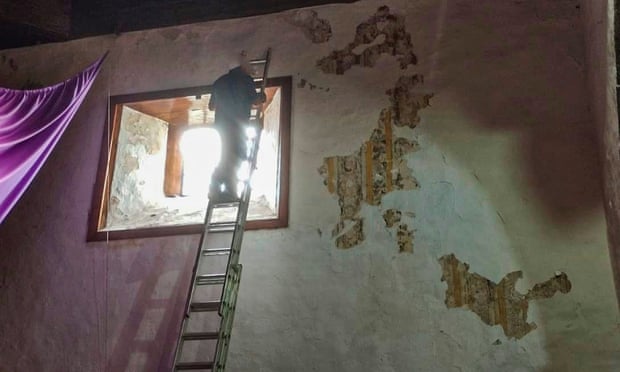
In a regrettable incident that has stirred emotions and sparked discussions across the Spanish island of Tenerife, a priest has found himself at the center of controversy after inadvertently ordering the painting over of a set of listed, 300-year-old frescoes in his parish church. The mishap occurred as the priest endeavored to prepare the church for Holy Week, a time of significance in the Christian calendar.
The affected church, dedicated to St. Anthony of Padua, stands in the town of El Tanque, where locals have voiced their dismay over the incident. The inadvertent erasure of these historical artworks has not only prompted an outcry from the community but has also initiated an investigation by the regional government of the Canary Islands.
The priest in question, Héctor Lunar, who hails from Venezuela and reportedly sought refuge elsewhere due to threats arising from his criticisms of the regime in his homeland, expressed deep regret over the incident. Lunar explained that he had been unaware of the protected status of the frescoes, which had been bestowed upon them more than a decade ago. The church itself, a structure with roots dating back to the 16th century, underwent reconstruction in the 18th century following destruction caused by a volcanic eruption in 1706. Remarkably, the frescoes, dating back three centuries, were revealed during restoration efforts approximately twenty years ago and were subsequently safeguarded with a layer of paint aimed at preserving their integrity.
Lunar, speaking to the local publication El Día, extended his apologies to the pertinent authorities and the community at large. He admitted to his lack of knowledge regarding the historical significance of the frescoes and acknowledged his failure to consult with the appropriate authorities before initiating the repainting efforts. Despite his oversight, Lunar expressed remorse, emphasizing that his intentions were rooted in the desire to enhance the church environment in preparation for religious events, particularly Holy Week.
While Lunar's apology has been accepted by the local religious brotherhood, questions linger regarding the oversight that led to this unfortunate incident. Esther Morales, the mayor of El Tanque, conveyed hope that the frescoes could be salvaged, pending evaluation by heritage experts. The sentiments of the local community echo this optimism, with a collective desire for swift resolution and restoration.
This incident has drawn comparisons to previous restoration mishaps in Spain, notably the widely publicized "Monkey Christ" restoration of 2012, where an amateur restoration attempt on a fresco in Borja garnered international attention. Such incidents serve as cautionary tales, underscoring the delicate balance between preservation and renovation in the realm of cultural heritage.
As investigations continue and efforts to rectify the damage unfold, the community remains hopeful for the restoration of these invaluable pieces of history, reminding us all of the importance of vigilance and expertise in safeguarding our cultural treasures.

