
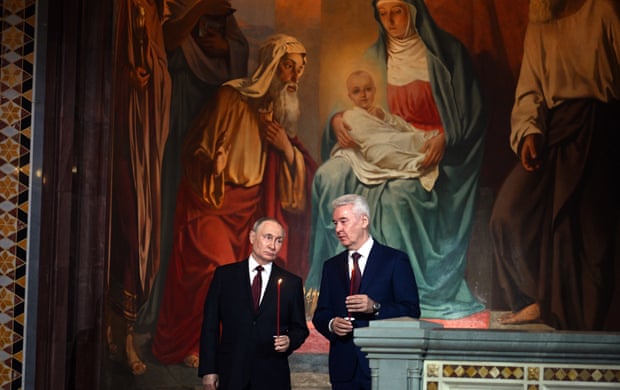
Vladimir Putin and Moscow’s mayor, Sergei Sobyanin, at Orthodox Easter service at Cathedral of Christ the Saviour. Photo credit: EPA
Orthodox Easter, a time traditionally marked by spiritual reflection and renewal, has taken on a distinctly political hue in Ukraine and Russia this year. As Orthodox Christians across the globe celebrate the resurrection of Christ, the shadows of war and political tension loom large over the holiday observances in both nations.
In Ukraine, President Volodymyr Zelenskiy delivered a poignant message during the Easter season, invoking themes of resilience and national unity in the face of adversity. Standing resolutely amidst the backdrop of ongoing conflict with Russia, Zelenskiy asserted Ukraine's steadfast determination to prevail, declaring, "God has a chevron with the Ukrainian flag on his shoulder." Clad in traditional attire, Zelenskiy's words resonated with a nation grappling with the harsh realities of war.
Meanwhile, in Moscow, Russian President Vladimir Putin attended an Easter service led by Patriarch Kirill, a staunch supporter of the Kremlin's agenda. The symbolic significance of Putin's presence at the service was not lost on observers, as the Russian leader crossed himself repeatedly alongside Moscow's mayor, Sergei Sobyanin. Patriarch Kirill's prayers for the protection of Russia's borders and calls for an end to the "internecine strife" with Ukraine underscored the intertwined relationship between religion and politics in the region.
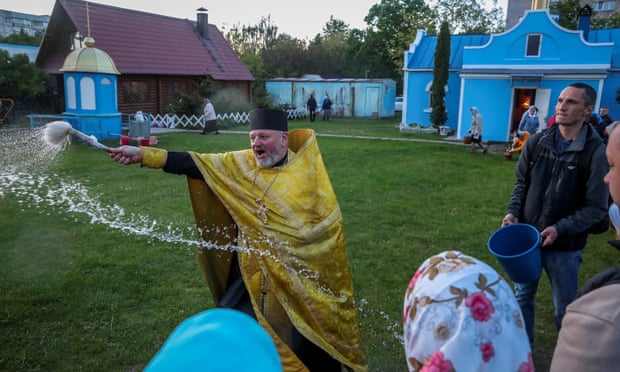 |
| A priest blesses people during an Orthodox Easter service in Chernihiv, Ukraine, on Sunday. Photo credit: Reuters. |
Putin's Easter message, while devoid of explicit references to the ongoing conflict, emphasized the importance of unity and cooperation during challenging times. His words of gratitude to Patriarch Kirill for their collaboration in fostering national development subtly acknowledged the role of the church in bolstering the state's objectives.
However, behind the veneer of religious observance lies a deeper narrative of dissent and suppression within the Russian Orthodox Church. Patriarch Kirill's tenure has been marked by a crackdown on internal dissent, with dissenting voices silenced and dissenters facing expulsion. The church's alignment with the Kremlin's agenda raises questions about its independence and impartiality in matters of state affairs.
Against this backdrop of political posturing, the grim reality of violence and bloodshed continues to cast a shadow over the region. Reports of rocket attacks and drone strikes serve as grim reminders of the human cost of conflict, with innocent civilians bearing the brunt of the hostilities. As casualties mount and homes are reduced to rubble, the urgency for a peaceful resolution to the conflict becomes ever more apparent.
Yet, amidst the chaos and turmoil, expressions of hope and resilience endure. In Kyiv, President Zelenskiy's impassioned plea for unity and solidarity reverberates within the hearts of Ukrainians, echoing a collective resolve to resist oppression and defend their homeland. As prayers are offered for the safe return of soldiers and the liberation of Ukraine, the spirit of resilience prevails, undeterred by the specter of war.
In the midst of political intrigue and military aggression, Orthodox Easter serves as a poignant reminder of the enduring power of faith and the resilience of the human spirit in the face of adversity.


