
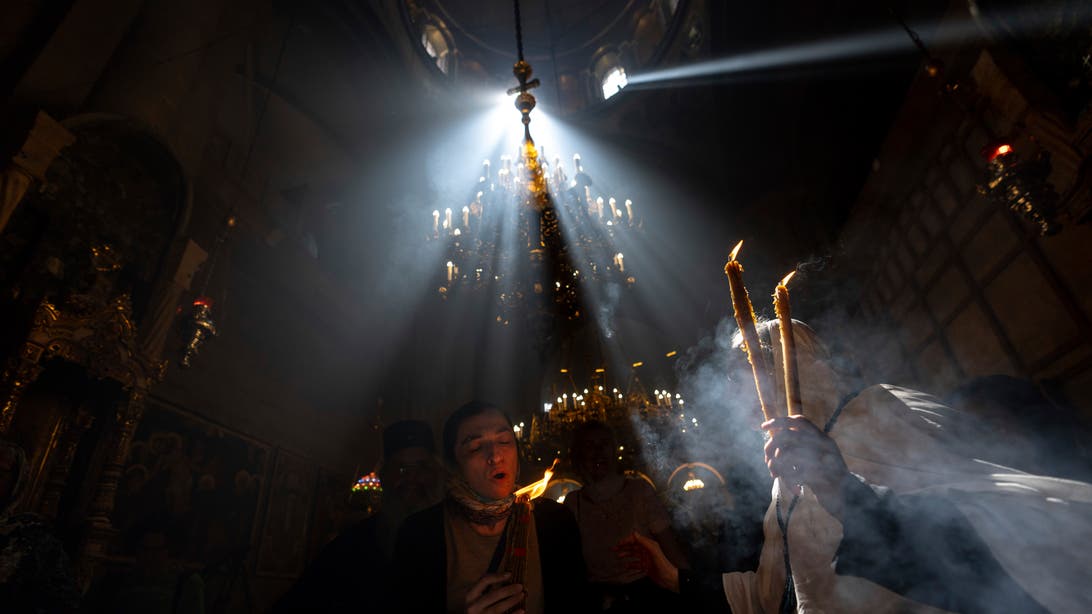
Every year, Orthodox Easter week in Jerusalem witnesses a sight both awe-inspiring and chaotic: the Ceremony of the Holy Fire. This ancient tradition draws throngs of Christian Orthodox worshippers to the Church of the Holy Sepulchre, transforming it into a sea of flickering flames, fervent prayers, and joyous commotion.
The Church of the Holy Sepulchre holds immense significance for Christians. Believed to be built on the very site of Jesus' crucifixion, burial, and resurrection, it serves as a powerful symbol of their faith. The Holy Fire ceremony adds another layer of spiritual weight to this sacred location.

A Tradition Steeped in Mystery
For over a millennium, the ceremony has captivated pilgrims and believers. The exact details remain shrouded in secrecy, adding to the mystique. On the eve of Orthodox Easter Saturday, a suspenseful anticipation hangs heavy in the air. The crowds jostle for position within the confines of the church, the clamor of bells intermingling with the fragrant haze of incense.
All eyes turn towards the aedicule, a small chamber within the church believed to house the tomb of Jesus. A designated patriarch, often the Greek Orthodox Patriarch of Jerusalem, enters the tomb alone. Prayers intensify as the crowd waits with bated breath. Moments later, a brilliant flame miraculously emerges from within the tomb, passed outwards through a small opening.
Elation erupts! Cheers and shouts of "Christ is Risen!" fill the air. Worshippers eagerly reach through the opening, their candles yearning for a touch of the Holy Fire. Soon, a constellation of flickering flames illuminates the once-dim chamber, a tangible symbol of the divine light brought forth from the tomb.
A Celebration of Faith and Hope
For many Orthodox Christians, witnessing the Holy Fire is a transformative experience. Angela Manoug, a first-time participant, describes it as an indescribable blessing. The sight of the faithful waving their flames, some even anointing themselves with the holy light, speaks volumes about the deep reverence it inspires.
The ceremony transcends the mere act of lighting candles. It signifies the renewal of faith, the triumph of light over darkness, and the everlasting hope offered by Jesus' resurrection. This year, however, the celebratory spirit was tempered by the ongoing conflict between Israel and Hamas. Worshipper Issa Assasieh poignantly expressed his wish that the Holy Fire might bring peace to the region.

A Ceremony with Complexities
The ceremony's popularity also presents logistical challenges. The limited space within the Church of the Holy Sepulchre often leads to friction with Israeli authorities, responsible for managing the crowds. Past ceremonies have witnessed dangerous stampedes, highlighting the need for stricter crowd control measures.
The Church of the Holy Sepulchre itself is a complex entity, shared by various Christian denominations. The ceremony is primarily led by the Greek Orthodox community, though Armenians and other denominations also play a role. This intricate web of custodianship adds another layer of complexity to the event.
A Powerful Symbol that Endures
Despite the logistical hurdles and ongoing political tensions, the Holy Fire Ceremony remains a potent symbol for Orthodox Christians. It is a testament to the enduring power of faith, a celebration of the light of Christ's resurrection, and a beacon of hope in times of strife. Every year, it draws believers from far and wide, transforming the Church of the Holy Sepulchre into a microcosm of fervent faith and joyous celebration.


