
 |
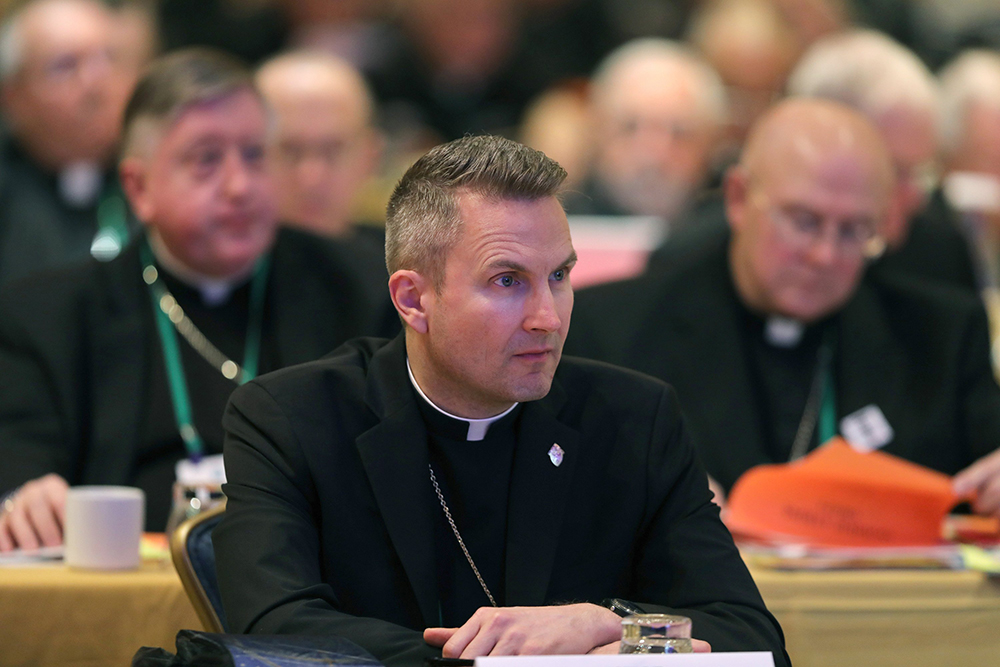
| Bishop Ronald Hicks of Joliet, Illinois, is pictured during the 2018 fall general assembly of the U.S. Conference of Catholic Bishops in Baltimore. Sixteen parishes in the Joliet Diocese will be reconfigured into seven parishes, with five churches closing, in order to optimize the diocese's resources for its future and evangelization efforts, Hicks announced Jan. 25. |
In a significant development for the Diocese of Joliet, Illinois, Bishop Ronald Hicks has declared the reconfiguration of sixteen parishes into seven, accompanied by the closure of five churches. The decision, announced on January 25, aims to strategically utilize the diocese's resources for its future sustainability and effective evangelization efforts.
Bishop Hicks emphasized the historical significance of this decision, noting that the Joliet Diocese has never embarked on a project of such magnitude before. The restructuring focuses on the Joliet Deanery, one of eight geographic subdivisions, encompassing parishes in and around the city of Joliet, southwest of Chicago – the diocese's see city.
The move follows a comprehensive yearlong process conducted by a diocesan committee to evaluate the future of the deanery. The committee's recommendations, accepted by Bishop Hicks after prayer and discernment, were revealed on January 25 after a consultation with the diocese's presbyteral council and college of consultors.
Bishop Hicks, who assumed leadership in September 2020, attributed the decision to significant changes over the past 50 to 60 years. Factors such as a decline in vocations to the priesthood, an aging clergy, aging church buildings in need of extensive repairs, lower Mass attendance, and a growing trend against organized religion have all played a role in shaping this reconfiguration.
The Bishop stressed that the present landscape of the Church differs considerably from previous decades, and the restructuring is a proactive response to address the challenges. He highlighted the decline in Sunday Mass attendance and collections, necessitating a redirection of limited financial resources towards ministry rather than staffing expenses and temporary fixes for aging buildings.
As of 2021, the Joliet Diocese boasted a Catholic population of 520,148, comprising 117 parishes and seven mission churches. Founded in 1948, the diocese reached its peak of 122 parishes in 2003 and 2004. Bishop Hicks acknowledged the closure of four parishes in the city of Joliet in 1982, 1991, 2003, and 2007.
The restructuring plan involves three groups of parishes, with each expected to witness the cessation of certain parishes. Two configurations will also witness the closure of two church buildings, while one configuration will involve the closure of a single church building.
Among the affected parishes are St. Anthony, St. Bernard, St. Joseph, and St. Mary Magdalene, which will be extinguished and merged into a new parish with worship held on the campuses of the former St. Joseph and St. Mary Magdalene. St. Anthony and St. Bernard churches will be closed.
In another configuration, Sacred Heart, St. Paul the Apostle, St. Jude, and St. Patrick – the diocese's oldest parish – will merge into a new parish, conducting worship on the campuses of the former St. Paul the Apostle and St. Patrick. St. Jude and Sacred Heart churches will be closed.
In Crest Hill, north of Joliet, St. Anne Parish will be assumed into St. Ambrose Parish.
Despite these changes, the Joliet parishes of Our Lady of Mount Carmel, St. John the Baptist, and the Cathedral of St. Raymond Nonnatus in northwest Joliet will remain unaffected. However, plans mention that when St. John the Baptist is no longer staffed by Franciscans, the parish will be assumed into the nearby St. Raymond, and a decision will be made about the potential closure of St. John the Baptist's church.
In addition to the parish restructuring, St. Paul the Apostle Catholic School and St. Jude Catholic School, both in Joliet, are set to close and be replaced by a new parish school operating on the campus of St. Paul the Apostle. Bishop Hicks envisions this new school as a model for surrounding schools, offering enhanced programming and exceptional academics rooted in Catholic teachings.
Bishop Hicks clarified that the anticipated closure of St. Matthew Parish School in Glendale Heights, 40 miles north of Joliet, in June 2024 is unrelated to the Joliet Deanery restructuring. Instead, it is attributed to significant enrollment loss over the past five years, a considerable annual deficit, and substantial loss of funds due to the sunset of the Illinois Tax Credit Scholarship.
The decision-making process considered multiple factors, including data points on priests, seminarians, parish finances, facilities' assessments, sacramental numbers, Mass attendance counts, and average seating occupancy at weekend Masses. Bishop Hicks emphasized that the reconfiguration aims to ensure the best use of existing parish facilities, address staffing and maintenance costs, and maintain a proactive stance for the future.
In concluding his announcement, Bishop Hicks expressed a desire for the diocese to be seen as proactive, emphasizing that, with deep faith in God, they are pruning structural branches to enable the Church to continue producing great fruit.


